Simple Suggestions Sound Serious October 15, 2015
Posted by Dr. Robert Owens in Uncategorized.2 comments
What is Occam’s Razor?
According to the physicists at the University of California, Riverside Occam’s (or Ockham’s) razor is a principle attributed to the 14th century logician and Franciscan friar William of Ockham. Ockham was the village in the English county of Surrey where he was born.
The principle states that “Entities should not be multiplied unnecessarily.”
Many scientists have adopted or reinvented Occam’s Razor, as in Leibniz’s “identity of observables” and Isaac Newton stated the rule: “We are to admit no more causes of natural things than such as are both true and sufficient to explain their appearances.”
The most useful statement of the principle for scientists is “when you have two competing theories that make exactly the same predictions, the simpler one is the better.”
This is the one that is generally used on the wall-to-wall news shows which so often describe our world for those who are information junkies and current event addicts so this is the one I will go with today.
Our ruling Elites try to convince us that America’s problems are too complex for we mere mortal taxpayers to understand. They want us to allow them and their acolyte bureaucracy to decide everything behind a veil and then hand down their infallible decrees on stone tablets from Olympus on the Potomac.
This arcane process raises the question, “If the running of our government is too complex for us to understand how can we expect low information voters to choose who is best to do when we cannot even know what or how needs to be done?” If this is truly the case than we have reached the limit of the American experiment, and government of the people by the people and for the people does not work.
As the Historian of the Future, as someone who has spent more than fifty five years studying and thinking about History, Political Science and current events I believe this seeming conundrum is an illusion. I believe we should apply Occam’s Razor to what remains of our social contract to preserve what is left of our heritage.
Here are what I believe to be simple solutions to the threads the Lilliputians are using to bind the American Gulliver to an express to oblivion.
First, jettison the Empire to save the Republic. Currently the United States has armed forces in over 130 countries. We’re committed to defend most of these countries against aggression. Where were these allies on 9-11? Where were they in Afghanistan? Why do we have treaties binding us to go to war to defend those who refuse to support us when we’re attacked? If these policies are counter-productive are there any alternatives?
Close the foreign bases and bring our troops home. Station them on the border to protect us from the on-going invasion of illegal immigrants who’re overloading our systems. If we need to project American power use the carrier battle-groups designed for that purpose. Protect America and rebuild our infrastructure. When asked what to do with the American Military after World War I Will Rogers said, “Get ’em all home, add to their number, add to their training, then just sit tight with a great feeling of security and just read about foreign wars. That’s the best thing in the world to do with them.” Jettison the Empire to save the Republic!
Second, declare our energy independence. Did any President ever have an energy policy which effectively dealt with the problems of oil production and supply? Did it work?
Reagan said, “The best answer, while conservation is worthy in itself, is to try to make us independent of outside sources to the greatest extent possible for our energy.”
Ronald Reagan also said, “Our national energy plan should not be a rigid set of production and conservation goals dictated by Government. Our primary objective is simply for our citizens to have enough energy, and it is up to them to decide how much energy that is, and in what form and manner it will reach them. When the free market is permitted to work the way it should, millions of individual choices and judgments will produce the proper balance of supply and demand our economy needs. ”
As soon as he became president, Ronald Reagan ended the price controls on domestic oil first imposed by Richard Nixon; these controls had contributed to both the 1973 Oil Crisis and the 1979 Energy Crisis. Almost immediately the price of oil fell, and during the 1980s America didn’t experience the gasoline lines and fuel shortages of the 1970s. In addition, the removal of price controls ignited a boom in domestic drilling which arrested America’s slide into energy dependence.
As to the energy questions: How do we end our dependence on foreign oil? How can we achieve the energy independence which every President since Nixon has said is a matter of national security? Using Reagan’s approach as a guide stop wringing our hands and moaning about our situation, stand up like our ancestors and boldly declare our Energy Independence! In practical terms we should: take the shackles off our domestic oil industry, build new refineries, develop better distribution of natural gas, expand the use of nuclear, wind, solar and every conceivable form of energy, and drill baby drill!
Third, end the de facto amnesty. Our President has made no secret of what his end game is. Remember him with Joe the plumber? Mr. Obama wants to spread the wealth around. He is perhaps not an avowed socialist however based on everything he does; he is effectively one. Yet he has won two elections one way or another and he is coordinating the end game of the Cloward-Piven Strategy. This is not a conspiracy…it’s a strategy to bankrupt America by overburdening the system….and it breaks my heart that as America dozed on the couch watching the game these Progressives have turned the American dream into a nightmare.
Now the Southern border has been all but erased by pre-arranged catastrophes. What does America’s Community Organizer in Chief do in response to these manufactured assaults by the children’s crusade and others? He unilaterally grants amnesty through executive edict to millions if not tens of millions while holding the door open for millions more.
Does the GOP move to block these unconstitutional acts of national suicide? Do they mount a national campaign to harness the vast majority of citizens who want to save America for Americans? No, the congressional Republican leaders let everyone know they are for amnesty too.
How can they not know that amnesty for millions of undocumented democrats is suicide for the GOP? Call it executive action. Call it comprehensive immigration reform. Call it anything you want. Amnesty under any other name is amnesty and amnesty with open borders is a siren call to the tens of millions who haven’t already come to come now. Our leaders are actually working on a plan to merge the United States with Canada and Mexico into a new super state of North America. Our children and grandchildren will grow up in a third world hellhole that was once the land of the free and the home of the brave. Close the borders or we give away our country.
Fourth, end the centrally planned welfare state. The most insidious result that central-planning and the overabundance of government control that it requires is not the maladjustments that it inevitably creates in the economy. It is not the crony capitalism and bureaucratic nepotism that it always fosters. It is not the smothering blanket of nanny-state regulations that strangle creativity. It is not even the tendency to one-party rule even when camouflaged behind a two party system that is in reality two heads of the same bird of prey. It is not a system which may actually contain only two parties if you believe there is the government party and the country party.
No none of these missteps on the way to an illusionary utopia are the most insidious result of any system no matter what it is called that is some variation on the socialist theme of “From each according to their ability and to each according to their need.” Instead the most insidious result of the effort by some to control all is a change in the character of the people.
When government regulation becomes an all-embracing web of minutia that requires lawyers, accountants, and other translators of government-speak to comprehend, when safety-nets become hammocks, and when the do-gooders believe that they know what is best for everyone reaches a tipping point people begin to expect others to do for them what they used to do for themselves. A nation of self-reliant, go-getters can be changed into a sea of slugs on the dole constantly crying and voting for more.
The descendants of the pilgrims and the pioneers are content to wait for their government check and their food stamps as long as there is a game on their flat screen and minutes left on their Obama phone. Militant apathy has ossified the sinews of a once great people. So many people don’t care about anything beyond their creature comforts, the most basic of which are guaranteed, that the will to succeed has been squashed.
Cut the strings of the hammock and people will learn to stand on their own two feet again.
And though the list is much longer, the last entry for today is one last simple solution for what we are told is a complex problem. Grow the economy instead of the bureaucracy to bring back prosperity, opportunity, and hope.
Business is like water. It follows the path of least resistance. A fact which should birth shame in the hearts of all Americans is that for the last decade American Businesses have been in a mad rush for the door. They’ve left America, once the epitome of free enterprise, choosing instead to establish them in Communist China. Today Federal red tape and taxes are strangling American free enterprise.
Innovation is like lightning. It comes in a flash, burns white hot, and is impossible to bottle. When free enterprise is stifled by government interference in the marketplace the incentive to develop and produce are stunted. Americans have always been the can-do people. We’ve always been the leaders in invention and innovation. Our entrepreneurs have traditionally led the world in new patents and processes. Back in 2011 many sources predicted China would take the lead in high tech patents applied for and new industrial processes pioneered and now they do. It takes thinking outside the box to find the new and provide the best. In America today the Federal Government has set to work making the box stronger, to weaving a mesh of regulations and taxes, and turning the box into a cage.
This isn’t rocket science. We aren’t trying to figure out the orbit perimeters of a sling-shot around the moon to reach Saturn. This is Political Science and Economics: the arcane arts of who gets what, when, and how.
If we want manufacturing and innovation to grow reduce taxes to the lowest in the world and take the steel boot of regulation off the throat of free enterprise and watch our manufacturing base and our industrial output soar. If you want more jobs stop stifling small business with uncertainty and watch the unemployment rate fall. If we want more consumer spending instead of the next round of bail-outs and stimulus pay-offs to campaign contributors give the American people a one year federal tax holiday and watch consumer activity go through the roof. In other words grow the economy not the bureaucracy.
Dr. Owens teaches History, Political Science, and Religion. He is the Historian of the Future @ http://drrobertowens.com © 2015 Contact Dr. Owens drrobertowens@hotmail.com Follow Dr. Robert Owens on Facebook or Twitter @ Drrobertowens / Edited by Dr. Rosalie Owens
More Wars for Peace Will Not Bring Peace October 8, 2015
Posted by Dr. Robert Owens in Uncategorized.4 comments
When Hamid Karzai, the man we installed and the leader of a land that is a nation in name only was the president of Afghanistan he accused the United States of colluding with the Taliban to keep the war going. According to his spokesman, “The people of Afghanistan ask NATO to define the purpose and aim of the so-called war on terror… (They) consider this war as aimless and unwise to continue.” Even our so-called allies believe there are ulterior motives behind our foreign policy. Yet most Americans swallow it whole.
I am a supporter of our troops. I believe they are patriots and America’s best. It is not the bravery or skill of our troops that I question; it is the imperial foreign policy which sends them as sacrifices on the altar of political ambition that I question. The cruel calculations of political elites using our service men and women as pawns on their partisan game board are shameful. One shocking example of this was transparently obvious when President Obama announced a surge in troops at the same time he announced the exit strategy for leaving the country. What could be more counterproductive than telling an asymmetrical partisan enemy that if they hang on long enough we leave and you win? Now, after fourteen years of blood, sweat, and tears we’re leaving, and they’re going to win.
Look at Iraq. We went to war to stop the spread of weapons of mass destruction which even President Bush eventually admitted were never there. We went to war because our leaders intimated that Iraq had a hand in the sneak attacks of 9-11 based on a rumored meeting between an Iraqi agent and Mohamed Atta another claim that has since been repudiated. Did we go to war to correct the partial victory we gained in Gulf War I under George I as claimed by some former Cabinet members? Did we go to war as George II later claimed to make the Mideast safe for democracy? Whatever the reason for invading Iraq, a nation we supported for years, a nation which had not and was not planning to attack us, what did we accomplish and what do we have now that we are gone? We are faced with the Islamic State and Iran has a satellite.
What about Afghanistan? After the sneak attacks on 9-11 we had every legal and moral right to attack the nation that harbored and protected Al-Qaeda. However, to keep faith with the Constitution a declaration of war should have been obtained. Our armed forces waged a brilliant campaign that dismantled the Taliban regime in short order. Then instead of saying, if it happens again we will come back again, and leaving we have stayed for ten plus years squandering hundreds of billions building a nation for people who don’t see themselves as a nation. They are a collection of tribes grouped together by the necessities of international politics surrounded by a porous border and a history of ungovernable conflict.
Does anyone doubt that after we leave Kabul the Taliban will return? Does anyone doubt that the training and weapons that we have given to our Afghan allies which are turned against us on a regular basis will form the bedrock of future Taliban strength? Does anyone doubt that as soon as we are gone Karzai and other Afghan patriots of his ilk will be leaving with 747s full of American tax dollars?
The Constitution gives Congress the exclusive right to declare war. This limitation on the prerogative of our chief executive to commit America to war without the consent of the citizens was considered one of the most important strengths of the document. The founders of our nation came from a society in which autocratic kings had often plunged their nations into wars based on their own desires, whims, and political machinations. Those who wrote the Constitution to be the framework for a new type of nation determined that we should never go to war unless it was the expression of the people through their elected representatives.
There hasn’t been a declared war since World War II, and yet our sons and daughters have fought and died in countless battles around the world. With the war in Afghanistan set to end next year the Neocons and Progressives are beating the war drums daily for intervention in Syria and war with Iran, and even push for war with Russia. Remember WWII? That was basically the whole world against the fascist powers of Germany, Italy and Japan. What is being offered here is a world war with us against everyone else.
Look at the debacles this aggressive policy is inserting into American History. The prime example is the disaster in Benghazi. I believe once the truth is known it was the CIA implementing the Obama Administration’s on-going policy of supporting Islamic Radicals supplying weapons to the Syrian rebels to overthrow another Arab dictator as we had just recently accomplished in Libya. I contend that the Mission in Benghazi and its satellite CIA Safe-House were in reality a conduit for transferring untraceable weapons from the captured Libyan arsenal through Turkey to the rebels. So when it comes to Syria we have instigated and supported this war for years. Now we are pouring money down rat holes training soldiers who melt into the enemy weapons in hand at the first opportunity. And even this isn’t enough. The Neocons want us to play the proxy army for the Sunni against the Shia in their long war of religious fratricide.
The same goes for Iran. There has been a shadow war raging for years between Israel and Iran with American support. This shadow war consists of assassinations of nuclear scientists, bombing nuclear facilities and uploading computer viruses into computers used to control the cyclotrons used to enrich uranium on the part of the allies. The response has been attacks against Israeli citizens around the world and even a bombing attempt in Washington D.C.
This was not enough. America led the world in imposing draconian sanctions against Iran. Sanctions which if imposed on us would be consider acts of war. Once again this is not enough. Now the Obama administration has concluded a deal with Iran that takes a step back from war. The billions of dollars that we are supposedly giving Iran are in reality Iranian dollars we have been holding up around the world due to the sanctions. Our own intelligence agencies continue to insist there is no evidence that Iran is even trying to build a bomb and yet the Neocons are working day and night to get us to deliver some shock and awe all over Iran all in the name of peace.
Iran has not attacked another country in the memory of anyone who is alive today. Or in the lives of the ancestors going back hundreds of years. America’s intelligence agencies unanimously tell us, Congress, and the Administration that Iran does not have a nuclear weapons program. Iran is a signer of the Nuclear Proliferation Treaty, and as a part of that treaty it is guaranteed the right to develop nuclear power for peaceful purposes. I know none of this will endear me to my more doctrinaire readers. The truth often does not fit into the insulated scenarios of ideology, which according to the law of paradigm thinking means that anything that does not fit is wrong. I am prepared to be wrong to get this right.
As part of the big push to get us into another war we are told that with regard to Iran “Containment is off the table.” Usually soon after we are told “All options are on the table” war is on the table. Why is containment off the table? It worked during the Cold War when we faced off with an enemy many times larger with thousands of nuclear weapons on delivery systems aimed at our cities. Why won’t it work against a nation that at this point has no nuclear weapons?
Why is it acceptable for North Korea to have nuclear weapons but not Iran? Does anyone think the Ayatollahs are crazier than the new boy dictator of the Kim dynasty? There is no doubt that the United States military has the ability to destroy Iran’s conventional defensive and offensive resources within a short time. It is obvious we could, “Bomb them back to the stone age” as the saying goes. However that wouldn’t necessarily mean that some of the stones thrown later in the contest might not hurt. Iran has an unknown asymmetrical war capability.
It is believed that their allies in Gaza and Lebanon would immediately attack Israel. The Iranians would also do all they could to interrupt the supply of the oil upon which we continue to allow ourselves to rely. They would attempt to attack the oil fields of their neighbors, to close the Straits of Hormuz, attack nearby American bases, and possibly stir up rebellions in Sunni ruled countries with either sizable Shiite minorities or in some cases majorities. We might even face terrorist attacks here in the Homeland. This war would not be a cake walk. The military and economic consequences would be immediate and they would be dire.
However, as dire as these consequences would be these are not potentially the most troubling. War opens the door for domestic changes that would not be possible during normal times. While we have been and are engaged in a multi-generational seemingly endless series of wars this war might be different. While all our other wars have been fought over there the civilian population continued to live as if Americans were not in harm’s way even though our sons and daughters were. In other words we managed to have both guns and butter, war overseas and peace at home. In the case of a war with Iran we might face a situation that could bring the war home to America in multiple ways.
Economically gas could skyrocket causing dislocation in our fragile economy. On the military front terror sleeper cells could be activated in America or terrorists could come in through our porous southern border, or we could import them ourselves through refugee relocation. Both the economic impact and terrorist activities would open the door for drastic government action which could well negatively impact our lives. Rights are often curtailed in times of emergency. The cost of war is often seen in the growth of government power and the loss of freedom at home.
Our worldwide military presence is not keeping us safe and in many ways it is provocative. Peace and equitable trade with all is the course recommended by our founders. It was the foreign policy of every administration until McKinley and the default position until FDR. Let us return to our traditions and reject these endless wars for peace. Let us quit supporting other economies with our foreign bases. Let us end the many entangling agreements that bind us to fight for others who should instead fight for themselves. It is time for patriots to see that more wars for peace will not bring us peace. What we need is real peace not a phony peace at home and endless war abroad.
With real peace we could perhaps deal with the domestic issues that are tearing us apart and driving us into bankruptcy. Every patriot should recognize the danger new fronts in our never-ending war will have on our current battle to maintain personal liberty, individual freedom, and economic opportunity here at home. Consequently patriots should do everything in their power to stop the stampede to war. Stand up for real peace and not for more wars for a peace that never comes.
Dr. Owens teaches History, Political Science, and Religion. He is the Historian of the Future @ http://drrobertowens.com © 2015 Robert R. Owens drrobertowens@hotmail.com Follow Dr. Robert Owens on Facebook or Twitter @ Drrobertowens / Edited by Dr. Rosalie Owens
Communicators Phasers Replicators Cloaking Device Impulse Drive and the Borg October 1, 2015
Posted by Dr. Robert Owens in Uncategorized.3 comments
In many ways I have always been a dystopian believing that the inevitable rise of a future technology enhanced totalitarian state will regiment and control a society that is as dehumanizing and as unpleasant as possible. I was influenced by early and repeated readings of such works as 1984, The Brave New World, A Clockwork Orange, and the Iron Heel. I was also influenced by the History of the Twentieth Century and the steady erosion of freedom in America that marks the evolution of the Progressive agenda. In spite of all that I also believe that technology has the potential to change the game and deliver us to an unexpected future.
Back in 2005 there appeared a two-hour television documentary, commissioned by Discovery Channel Canada and co-produced for History Channel in the United States and Channel Five in the United Kingdom., How William Shatner Changed the World. In this well-done and very interesting film William Shatner presents a light-hearted look at how the “Star Trek” TV series has influenced and inspired today’s technologies including: cell phones, medical imaging, computers and software, SETI, MP3 players and iPods, virtual reality, and spaceship propulsion.
Ever since, I have been recommending that people watch this as a way to inform them of how much science fiction is becoming science fact. Several recent announcements have spurred me to devote this week’s column to a more public pronouncement about where technology is leading us.
Think about the Star Trek franchise where there was the original Star Trek, then the Next Generation, Deep Space Nine, Star Trek: Voyager, Star Trek: Enterprise, the movies, and even an animated series. For decades these imaginative shows have tantalized us about a future where humanity has left the death cage of a world that has been repeatedly almost wiped clean of life by meteors, volcanoes, and ice ages. It is only by spreading beyond the womb of our home world that humanity can ensure its survival.
Technology also offers the prospect of transforming our societies and cultures in ways we need to examine unless we intend to fly into the future blind.
Wikipedia, the much maligned open user source that is much more accurate than it is generally believed has a good synopsis of what the documentary covers:
First hour
The first hour focuses on the original Star Trek series and the ideas that Gene Roddenberry had about the future of space travel.
It begins with the life of Dr. Marc D. Rayman, the chief propulsion engineer at NASA’s Jet Propulsion Laboratory, and shows how Dr. Rayman became interested in propulsion through Star Trek. It also discusses how NASA’s newest deep space probe’s ion propulsion was inspired by the Star Trek episode Spock’s Brain. Shatner also states that “those pesky trekkies are everywhere in the space program,” hence the name for the first Space Shuttle: Enterprise.
The show then examines the life of Martin Cooper, the chief engineer at Motorola, who invented the cell phone. Cooper states that Star Trek was his inspiration for the cell phone, and discusses the similarities between the modern day cell phone and a Star Trek communicator. He also discusses how Star Trek introduced the concept of computer voice recognition dialing.
Next, Mae C. Jemison describes how Star Trek inspired her to become the first African-American in space, and Seth Shostak, of SETI (Search for Extra Terrestrial Intelligence), tells how it led him to astronomy.
The show also explores how Star Trek popularized the notion of the user-friendly personal computer, and how Trek fan Ed Roberts, invented the first home computer, the Altair 8800, named after the solar system Altair (Altair 6) in the Star Trek episode Amok Time. This led to Bill Gates writing the computer programming language BASIC for the Altair and forming Microsoft.
Medical technologies are discussed, in particular the inspiration for non-invasive Star-Trek-style imaging technology.
Warp drive and faster-than-light interstellar travel with theoretical physicist Miguel Alcubierre‘s theories are mentioned. Lawrence M. Krauss, physicist and author of The Physics of Star Trek, is also featured.
The show then investigates the research work of Kevin Warwick at the University of Reading and considers its links with the Borg. Warwick’s cyborg implants, linking his own nervous system into the internet, are featured.
Second hour The second hour focuses on further programs in Star Trek franchise: Star Trek: The Next Generation, Star Trek: Deep Space Nine, Star Trek: Voyager and Star Trek: Enterprise and their impact and how they differed from the original series.
Next up is Steve Perlman, at the time principal scientist at Apple Computer, who was inspired to invent the QuickTime media player by watching an episode of Star Trek: The Next Generation.
As eye-opening as this documentary was it first saw the light of day back in 2005. That was ten years ago, and according to Moore’s Law, based on the observation made in 1965 by Gordon Moore, co-founder of Intel that the number of transistors per square inch on integrated circuits had doubled every year since the integrated circuit was invented and his prediction that this trend would continue for the foreseeable future, there has been an exponential rise in computing power every year since. With rising computing power comes acceleration in the speed of innovation based upon the research and design enhancement that computing power provides. So where are we today?
Communicators: Remember the two way links provided by those handy little medallions the Star Trek crew wore? They could speak to the ship and each other. Never more than a click away everyone was in constant communication. When we first saw these most of us still had rotary dial phones and only the rich and powerful had something we called a car phone. Today more people on Earth, six out of seven billion, have access to cell phones than have access to toilets. And on those cell phones we not only have audio communication on mobile devices we have video, face-time, pocket computers, calculators, and cameras.
Phasers: In the real world we call these lasers, and they have been real for a long time. Used in many ways lasers have become a part of everyday world with laser pointers and laser cutting. Today after decades of development and testing they are moving into the world of weapons. The U.S. Navy has already mounted them on ships and they are being tested on jet fighters, drones, drone killers, and rifles.
Replicators: In the real world we call them 3-D printers and they are already being used to:
- Print organs used in medical procedures, and to create prototypes for manufacturing speeding up the time needed to develop new products. Anthony Atala at Wake Forest’s Regenerative Medicine department was able to create artificial scaffolds in the shape of an organ with living cells. First the scaffold is printed and then it is coated with living cells. Now the Regenerative Department is working on building 3D printers that can print artificial scaffolds and living cells at the exact same time.
- Ford Motor Company uses 3D printing to make prototypes of many parts in their vehicles, such as cylinder heads, brake rotors, shift knobs and vents. 3D printing was used at Ford’s Torrence Avenue Assembly Plant for the production of the Explorer and EcoBoostJim Kor and his team of engineers are building a whole vehicle with 3D printers called the Urbee 2. The body of the original Urbee was made through the use 3D printing. However, the Urbee 2 as a whole will be mostly 3D printed. The Urbee 2 will also look more like a production-ready car compared to the original.
- NASA has fabricated rocket engine injectors. NASA is also going to send a 3D printer into outer space as part of a plan to set up a “mini factory” at the International Space Station (ISS). If astronauts run out of tools, they would simply be able to print out more. Astronauts would no longer have to carry spare parts for each mission.
- Defense Distributed a high tech gunsmith group created a fully open-sourced 3D printed gun. Fifteen of the gun’s sixteen parts were made out of 3D printed plastic and the body can be etched overnight.
- Tariq Rahman of the Nemours Biomedical Research facility at the Alfred DuPoint Hospital For Children worked with engineers at the hospital to build a durable exoskeleton that is helping those who cannot walk do so.
- In Japan, Yahoo! is working with a creative agency called Hakuhodo Kettle to help a school for the blind. Yahoo! is teaching blind children to search the web using a machine called Hands On Search. The Hands On Search is shaped like a cloud and it combines voice recognition technology with a MakerBot 3D printer to turn voice queries into physical objects.
It may be a few years before we all have 3-D printers in our homes or before we can merely say, “Earl Grey Tea – Hot” and have it appear in a cup ready and waiting; however, at this rate it may not be long.
Cloaking Device: In the Star Trek universe the Romulans were always popping in and out of view with their cloaking device. This was a stealth technology so advanced that it not only made their war ships invisible to enemy technology it made them invisible to the naked eye.
Today scientists are hot on the trail of invisibility. Step by step and inch by inch we are coming closer and knowing the way the military has what we think is impossible long before we know it is reality many believe it is already in use. In a reversal of the old saying, “What you don’t know can’t hurt you,” invisible war ships, planes, tanks, and men will be extremely difficult to counter. Except by blind luck you can’t hit what you can’t see
Impulse Power: This is the slower than light drive used in Star Trek. It may be slower than light speed but it is way faster than the primitive solid and liquid propulsion systems we have been using to dip our toe into the space faring sea. The ships of the Federation in the Star Trek universe used it to zoom around inside solar systems and that may be a close approximation of what is looming on our horizon.
The no longer secret development of the Electromagnetic Drive (EM Drive) is about to take human space exploration to a whole new level. Imagine going to the Moon in four hours or to Mars in ten weeks. This is what scientist are telling us is the potential for the EM or Electromagnetic Drive being called an impossibility that works because it violates Newton’s Third law of Physics “For every action there is an equal and opposite reaction.” It produces thrust by using solar power to generate multiple microwaves that move back and forth in an enclosed chamber. This means that until something fails or wears down, theoretically the engine could keep running forever without the need for rocket fuel. Once it starts it is that holy grail of pseudoscience: perpetual motion. Everyone knows perpetual motion is impossible. The only problem is that it works.
This is being called a reactionless drive. Reactionless drives lack the “reaction” defined in Newton’s Third Law so for this to work there must be an as-yet-undefined phenomenon taking place or our current understanding of physics is completely wrong.
With this technology it becomes feasible for humanity to make a real beginning of mass exploration and one day migration to the stars. We are poised to leave the womb of the world and be re-born as a star faring race. One day soon we may have cousins on Mars and brothers on the Moon. One day soon we may leave ourselves and help secure the survival of humanity in this cosmic pinball machine where eventually a meteor will punctuate our equilibrium.
And there is the Borg. Which, according to Memory Alpha, “were a pseudo-species of cybernetic beings, or cyborgs, from the Delta Quadrant. No single individual truly existed within the Borg Collective (with the possible sole exception of the Borg Queen), as all Borg were linked into a hive mind. Their ultimate goal was the attainment of ‘perfection’ through the forcible assimilation of diverse sentient species, technologies, and knowledge. As a result, the Borg were among the most powerful and feared entities in the galaxy, without really being a true species at all.”
Is there any possibility that we are the seed of the Borg? According to Ray Kurzweil, arguably one of the most intelligent men to have ever lived and demonstrably one of the most prescient futurists of all time in his seminal book The Singularity Is Near: When Humans Transcend Biology it is not only possible it is coming soon to a reality near you. According to About the Book in this book Kurzweil examines,
The next step in this inexorable evolutionary process: the union of human and machine, in which the knowledge and skills embedded in our brains will be combined with the vastly greater capacity, speed, and knowledge-sharing ability of our own creations.
That merging is the essence of the Singularity, an era in which our intelligence will become increasingly nonbiological and trillions of times more powerful than it is today—the dawning of a new civilization that will enable us to transcend our biological limitations and amplify our creativity. In this new world, there will be no clear distinction between human and machine, real reality and virtual reality. We will be able to assume different bodies and take on a range of personae at will. In practical terms, human aging and illness will be reversed; pollution will be stopped; world hunger and poverty will be solved. Nanotechnology will make it possible to create virtually any physical product using inexpensive information processes and will ultimately turn even death into a soluble problem.
If this sounds too farfetched consider these recent headlines:
- DARPA is testing implanting chips in soldiers’ brains
- The Age of Enhancement: Technology is starting to give us superpowers once reserved for comic-book heroes.
- Building the Real Iron Man
- The Real Cyborgs
- Plugging In Your Brain and Body – The Future Of Implanted Computers
- Brown University creates first wireless, implanted brain-computer interface
- Intel: Chips in brains will control computers by 2020
- Will Microchip Implants in Humans Become Mandatory?
After even a cursory search of the Net, just a few clicks and these types of stories begin to appear endless. This isn’t pie-in–the-sky sometime off in the future somewhere, this is today. This is happening now. There is a mad dash to enhance and improve upon God’s creation: man. In our infinite wisdom we have decided that it is time to take control of evolution and kick it up a notch.
When I speak to people about this aspect of the near future I am often told, “I’ll never get any of that implanted in me.” I always answer with this question, “If someone invents a chip that is implanted with a simple shot that makes you 1000 times more intelligent and you don’t get it, how do you compete with those who have?”
I have yet to receive a satisfactory answer.
As the Historian of the Future I am compelled to point out that the current events of today are the History of tomorrow, and just as the past is always the past the future is yet to be. We live in a constant present where, as the future slides into the present the present slides into the past and our lives are the History of the future. So live your life as if it matters. Face the future with a consciousness of the past so that the present can be used to shape what the future will be. Because it is coming whether we want it or not, and resistance is futile.
Dr. Owens teaches History, Political Science, and Religion. He is the Historian of the Future @ http://drrobertowens.com © 2015 Contact Dr. Owens drrobertowens@hotmail.com Follow Dr. Robert Owens on Facebook or Twitter @ Drrobertowens / Edited by Dr. Rosalie Owens
New Book By Dr. Robert Owens September 30, 2015
Posted by Dr. Robert Owens in Uncategorized.add a comment
Dr. Robert Owens announces his newest book:
Political Action Follows Political Philosophy: More Dispatches From the History of the Future
The vast majority of human action reflects the thoughts, beliefs, and feelings of the actor. There have always been and there will always be those whose actions are erratic or divorced from reality. The actions of this small minority are best ascribed to pathology not philosophy. For the rest of us, we think therefore we are. What we think about today we act upon tomorrow. The Dispatches from the History of the Future contained in this book convey the basic political philosophy which I believe will one day re-inspire our nation to stride upon the stage of History with another round of liberating political action.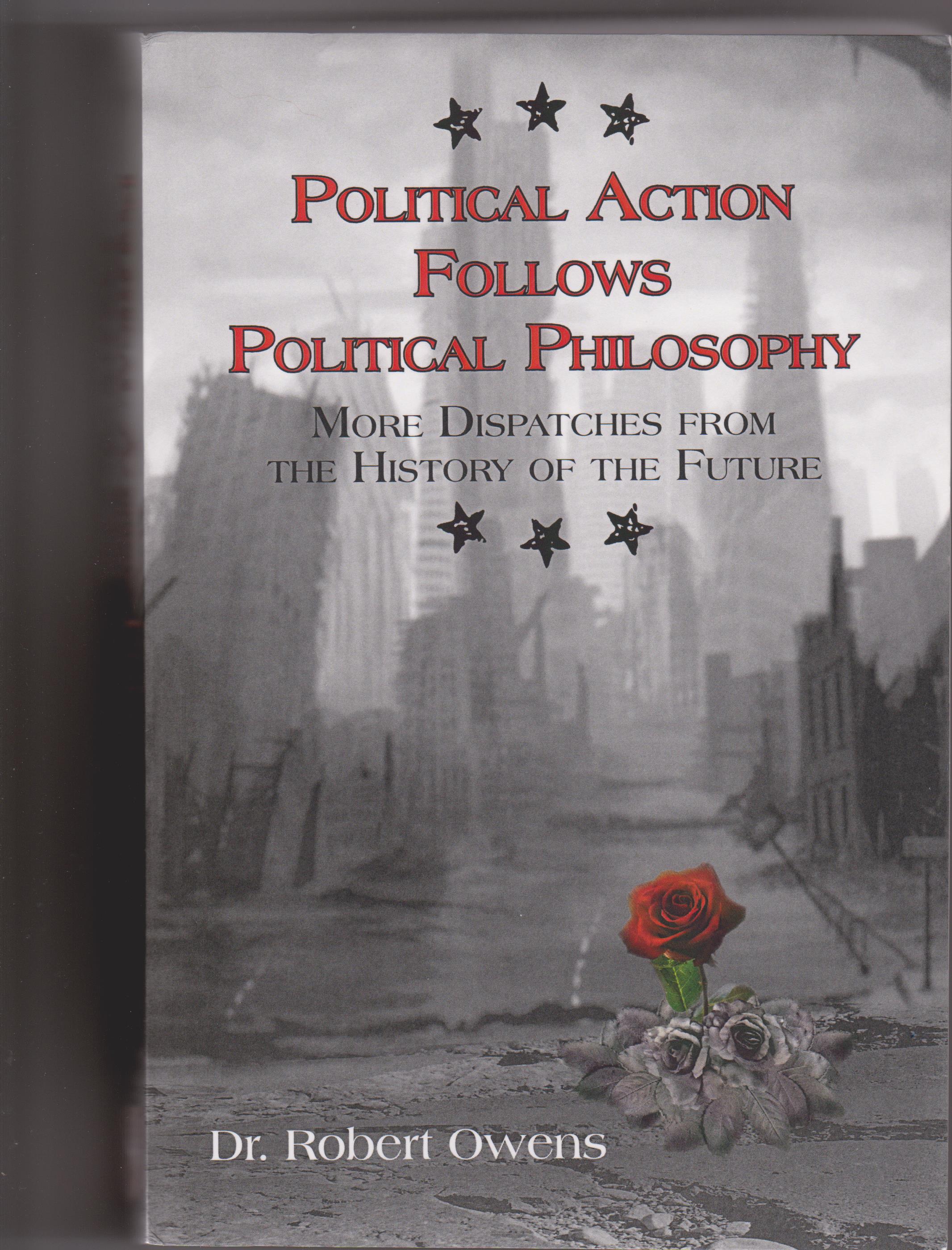
Now available on Amazon.com
And other sites online.
You can also request that your local library obtain a copy.
What Can’t Happen Here Did September 24, 2015
Posted by Dr. Robert Owens in Uncategorized.5 comments
Revolutions happened in other countries. That great slave house of nations the USSR, their satellite countries in Eastern Europe and Asia, African countries and of course those banana republics somewhere down south but one thing is for sure, it can’t happen here. Following in the footsteps of giants who have used these prophetic words of Sinclair Lewis I want to examine how it did happen here.
In the America of George Washington, Thomas Jefferson, and James Madison, the America we inherited from our forefathers, we knew that there could never be a revolution. We had the Constitution with its checks and balances, its separation of powers, and its Bill of Rights. These were rock solid, carved in stone, and strong enough to preserve the Republic and safe guard the freedom of its people.
Besides the American people would not stand for some wannabe dictator and his brown, black, or whatever color shirt followers marching through the streets and into the White House. The sons of the Pioneers wouldn’t sit still for any attempt to curtail limited government, personal freedom, or economic opportunity. No way! No how! Others might accept censorship, surveillance, and rigged elections but not us, not Americans. We had fought wars to defend our independence, wars to defeat totalitarianism; we had even fought wars to spread freedom. No, we wouldn’t quietly allow homegrown tyrants to grasp the levers of power.
It sounds so comforting, “It can’t happen here.” If you take a beginning Political Science class in either High School or College you will learn how the government works. How bills become laws, how the legislature is made up of the freely elected representatives of the people, how the President runs the executive branch and the Supreme Court sits atop the judicial branch. You will learn about the Declaration of Independence and how the Constitution was written to replace the Articles of Confederation which were too weak to work. Yes, you will learn all about how it’s supposed to work.
In most schools you will also learn that the Constitution is a “living Document” that can be re-interpreted to fit every generation and every age. The results of 100 years of re-interpretation have led us to the brink of ruin and me to recommend that the study of the Constitution should be moved from Political Science to History since what rules us today is legal precedent and bureaucratic regulation. The courts use foreign laws and traditions to interpret our laws and traditions. The legislature passes laws they don’t read filled with thousands of pages of vague platitudes and goals that the bureaucrats fill in with no oversight and the force of law. And the President does whatever he wants and no one says a thing.
So how did America fall for the second oldest con in the world, “Give me your freedom and I’ll give you security?”
Those who wished to gain power had no ideology or theology which inspired them. They only sought power for power’s sake. They espoused whatever populist themes gave them the broadest support. To bring as many interest groups as possible into their coalition they embraced an “I’m okay you’re okay” relativity that rejected absolutes and extoled the fringe as the mainstream.
And all the while the decedents of the blacksmiths and farmers who once congregated on corners to discuss the latest political pamphlet or to debate the merits of economic policy snoozed on the couch waking up long enough to go to work or watch the game.
The Revolutionaries of the New America first took root in the faculty lounges of academia providing the intellectual and cultural cover for an American movement that promoted the opposite of everything America stood for. From the classrooms of our colleges, came the next generations of teachers, journalists, lawyers, artists, and politicians. Soon it was common knowledge that our once rock-solid Constitution was a Living Document to be twisted and changed whenever those in power found the need.
From here it was just a matter of time until a revolution was accomplished through evolutionary change. Once the centers of power were secure in Washington, Hollywood, and in the media the trickle of change became a torrent and the torrent became a tsunami. Two wings on the same bird of prey, perpetually re-elected representatives from the twin headed party of power pander to the lowest common denominators, buying votes, using taxes to punish enemies and tax money to reward friends.
Our tyrants-in-training have captured the government and the economy, created a dependent class of motor-voters, convinced people that a continually growing debt is sustainable and turned the government into the one who picks winners and losers instead of a free economy. The slow slide down a slippery slope has accelerated into a precipitous procession over a predictable precipice. To those who have seen this coming it is like watching a slow motion train wreck. The coming destruction is not mitigated in the least by the decades or warning.
Our prideful boast of it can’t happen here has become a heart wrenching analysis of how it did happen here. How did the Progressives capture our land and subvert our Republic? They did it gradually inch by inch, step by step. When they lost a round they held their gains and as soon as possible recovered their long march toward a fundamentally transformed nation.
How they changed it brings us to the question, “How do we change it back?”
Violent revolt is both repugnant and obviously suicidal to people who understand that once that genie is out of the bottle there is no way to know which way it will go, except that the odds are heavily against it ever landing back in a stable land of limited government and personal freedom. The power of the state is overwhelming. Millions of shot guns, pistols, and even those terrible assault rifles we are constantly being lectured about would make no headway against Abrams tanks and F-18s.
There are only two ways to have a successful peaceful revolution. One: the vast majority of the people must go on strike and refuse to operate as a society until the changes have been made. Or two: it must happen gradually line upon line verse upon verse always keeping the goal in sight and moving forward at every opportunity. In other words we must do to the new establishment what they did to the old: not overthrow it. Supplant it and replace it in the hearts and minds of the people.
We can rest assured that all people at all times eventually yearn for freedom thus the stage is set by the very nature of man that God imprinted on us in His creation. Free choice is the natural state of man and in the end we will return to it. This pall of totalitarianism which is falling like a shadow across the land will one day awake to find the light of liberty cannot be quenched forever.
What should we do? Education is the key. If you are not a teacher become one. Learn to show yourself approved. Teach anyone who will listen of freedom, of the true History of the American experiment. Become involved in any way you can to retake control of our education system so that we can train the coming generations to love freedom, truth, justice, and the American way.
And don’t lose hope. God created us to be free and though tyrants always seek to ensnare people in their self-serving systems we will one day be free again. Draw near to God and He will draw near to you. Remember what we thought couldn’t happen here did, and what they think can’t happen to them will. Freedom will rise from the ashes, and one day the light of liberty will once again burn brightly in America the beautiful.
Dr. Owens teaches History, Political Science, and Religion. He is the Historian of the Future @ http://drrobertowens.com © 2015 Contact Dr. Owens drrobertowens@hotmail.com Follow Dr. Robert Owens on Facebook or Twitter @ Drrobertowens / Edited by Dr. Rosalie Owens
Why They Lie To Us September 18, 2015
Posted by Dr. Robert Owens in Uncategorized.5 comments
There are some things that are more than uncomfortable, they are almost unbearable.
One of those things is poverty. They say if all you have ever known is poverty it isn’t so bad because you don’t know any better. I always think that people who say that have never been poor. Since from time immemorial there has always been someone who has it better and if not there is always the iron clad law of “The Grass is always greener in someone else’s pasture.”
When Glug the caveman dragged himself back to his little efficiency cave and tried to feed his wife and kids with the little rabbit he was able to kill and his neighbor Gork in his sprawling Mammoth Cave compound next door feasted his family and the local witch doctor on prime rib of mastodon you can bet Glug knew the difference even though he had never experienced the difference.
However there is something even worse than being poor. That is being poor again.
Another of those nearly unbearable things are people who lie to your face over and over and over and they continue to lie to your face even when they know you know they are lying?
However there is something worse than this. That is being so pliable that you never call them on the lie. Maybe it is because you have never taken the time to investigate their statements enough to recognize a lie. Perhaps it is because you have heard the lie all your life and you have merely accepted it as fact. Or could it be because standing up and telling liars they are lying takes moral courage, internal fortitude and backbone.
As Lenin, Adolf Hitler, his propaganda Minister Joseph Goebbels and many other totalitarians, utopians and other statists have often said, “A lie told often enough becomes the truth.” This is the operational dictum our Elites seem to be operating on. From every mouthpiece and source the lies are trumpeted over and over. From the classroom to the newsroom, from the debate to the campaign, from the courthouse to the capital over and over the party line goes forth.
Our Elites appear to operate on principles gleaned from George Orwell’s 1984, such as; “And if all others accepted the lie which the Party imposed—if all records told the same tale—then the lie passed into history and became truth. ‘Who controls the past’ ran the Party slogan, ‘controls the future: who controls the present controls the past.’” They use words in the same fashion as Orwell’s Ministry of Truth, “War is peace. Freedom is slavery. Ignorance is strength.”
And our Elites’ dual headed party of power seems to have adopted the guiding philosophy of Orwell’s Party. “The Party seeks power entirely for its own sake. We are not interested in the good of others; we are interested solely in power. . . . Power is not a means; it is an end . . . not power over things, but over men. . . . In our world there will be no emotions except fear, rage, triumph, and self-abasement. . . . There will be no loyalty, except loyalty toward the Party. There will be no love, except the love of Big Brother. . . . Always, at every moment, there will be the thrill of victory, the sensation of trampling on an enemy who is helpless. If you want a picture of the future, imagine a boot stamping on a human face forever.”
Every candidate and commentator whenever they refer to illegal immigration they base their profundities on the figure 11 million illegals. Whether they were for them or against them this was the figure everyone agreed on. Listen to the news. Read the newspapers. Tune in to the endless campaign commercials. Listen to a lecture in a public classroom and this is the number you will hear every day, all day, and at least twice on Sunday. It might be 11 million living in the shadows. It might be 11 million who need to be deported. It might be 11 million who are doing the jobs Americans won’t do. Whatever the context, it is always the same number. So no matter how the world seems to have changed around us the number leveled off at 11 million. War is peace. Freedom is slavery. Ignorance is strength.
The interesting thing about that number is that it hasn’t changed since 2005 and even then so-called experts on counting the uncountable thought there could be as many as 20 million. Have people stopped coming? Does the immigration service run the country with the efficiency of security guards at an overcrowded Walmart; no one comes in unless someone else leaves?
And this is not the only example.
Think of the Vietnam War. It ended in 1973 with the Paris Peace Accords. Henry Kissinger won the Nobel peace Prize for negotiating this peace. In these accords North Vietnam acceded to our demands, they stopped fighting and returned the known and acknowledged POWS. In 1973 America won the Vietnam War: all combat troops left and for the United States the war was over.
For two years the South Vietnam we had fought to protect stood as an independent nation. They held a democratic election, the opposition won, and there was a peaceful transfer of power. Then in 1975 after so many former anti-war and anti-government agitators had been elected what was then called the Watergate Congress made it abundantly clear that no matter what happened we would not support or even re-supply the South the North invaded. The dispirited southerners threw down their guns and surrendered.
Every time the Vietnam War is mentioned in print, in class, on TV, or radio we are told it was a debacle, we lost, it was a mistake, and we are regaled with photos of people hanging from helicopters trying to escape the victorious communists or of bulldozers pushing planes off aircraft carriers. The problem with these pictures are that the people hanging from the helicopters were our South Vietnamese allies whom we had abandoned to the communists and the planes being pushed off the decks of our carriers were South Vietnamese jets and we were trying to make room for more to land who were fleeing the collapse we had caused.
If we left in 1973 as victors of the Second Vietnam War and the Third Vietnam War ended in 1975 how do you lose a war if you aren’t there?
Other lies that are force fed to a silent nation:
Women are a minority.
Illegal Immigrants only take the jobs Americans won’t do.
The national debt is sustainable.
There is no inflation.
Unemployment is ___%
The Supreme Court issues settled law.
Due to the restraint of time and space this list is not meant to be all inclusive.
How long will we sit silent as we are fed these lies? What happens if we sit for too long? We eventually tune them out or we come to act as if what we are spoon fed is true. Either way the Elites win as We the People are forced to pay taxes to hire teachers to indoctrinate our own children in the lies.
We all know that the truth is the truth and non-truth is the lie. Yet because of political correctness, peer pressure, and the uniformity of the media megaphone we know that some truths must never be said and some lies are repeated endlessly.
Looking to the examples given to us in Orwell’s 1984:
“Freedom is the freedom to say that two plus two makes four. If that is granted, all else follows.” And, “For, after all, how do we know that two and two make four? Or that the force of gravity works? Or that the past is unchangeable? If both the past and the external world exist only in the mind, and if the mind itself is controllable – what then?”
Why do they lie to us? Because it advances the agenda, maintains the power of the Elites and because we allow it go on this raises the same question, “What then?”
Dr. Owens teaches History, Political Science, and Religion. He is the Historian of the Future @ http://drrobertowens.com © 2015 Contact Dr. Owens drrobertowens@hotmail.com Follow Dr. Robert Owens on Facebook or Twitter @ Drrobertowens / Edited by Dr. Rosalie Owens
Who Was Jim Crow and Why is He Calling Me a Racist September 10, 2015
Posted by Dr. Robert Owens in Uncategorized.1 comment so far
When All in the Family made its big splash back in the 1970s I couldn’t see why it was supposed to be a comedy when it reflected the home I grew up in so closely. I looked for cameras outside our windows. Yet I bought into MLK’s vision of a color-blind America. I wanted and still want to see a land where people are judged by the content of their character instead of by any arbitrary circumstances, skin color, social class, nationality, or anything else.
In the segregated South and the bigoted North of my youth I could see the injustice and I applauded the opportunity to strive for a society built upon the best and the brightest. After generations of trying to get there all I can ask is “Are we there yet?” And if the answer is no after the expenditure of trillions of dollars and after the imposition of quotas, set asides, busing, and other court mandated absurdities when are we going to be there?
I say absurdities because the very idea that a government that seeks to end all discrimination based on skin color uses guidelines and policies based on skin color is patently absurd. Or at least it would have been considered so before we went through the looking glass from a constitutionally limited government of the people by the people and for the people to an all-powerful regime with an imperial president ruling by decree and a black robed priesthood able to make laws like the almighty writing on stone tablets.
Looking at the current political environment in America as shaped by generations of revisionist History and perpetually repeating the Democrat Party line by the Corporations Once Known as the Mainstream Media anyone could easily believe the lie that the Democrat Party has always been the champion of Civil Rights fighting the good fight against the reactionary Republicans. Nothing could be further from the truth.
Before the Civil War the Democrat Party was the party of slavery fighting tooth and nail to block any restriction on the spread of that foul institution. It was the Democrats who led the South out of the Union and who dominated the Confederacy the entire time it fought to preserve its peculiar institution. After four terrible years of war the Republicans imposed the ratification of the Civil War Amendments (13th, 14th & 15th) as a precondition for the defeated southern States to re-enter the Union as full members as opposed to conquered territories. The Civil War Amendments protected equality for emancipated slaves by banning slavery, defining citizenship, and ensuring voting rights.
These federally imposed measures worked as long as the North kept an occupying army in the Southern States during Reconstruction. The freed slaves were able to vote and they responded by electing Republicans to power in the South. During this time the newly freed slaves made many advances in education and economics as well as in political liberty throughout the South.
How did Reconstruction end?
According to American History:
As time passed, it became more and more obvious that the problems of the South were not being solved by harsh laws and continuing rancor against former Confederates. In May 1872, Congress passed a general Amnesty Act, restoring full political rights to all but about 500 Confederate sympathizers.
Gradually Southern states began electing members of the Democratic Party into office, ousting so-called carpetbagger governments and intimidating blacks from voting or attempting to hold public office. By 1876 the Republicans remained in power in only three Southern states. As part of the bargaining that resolved the disputed presidential elections that year in favor of Rutherford B. Hayes, the Republicans promised to end Radical Reconstruction, thereby leaving most of the South in the hands of the Democratic Party. In 1877 Hayes withdrew the remaining government troops, tacitly abandoning federal responsibility for enforcing blacks’ civil rights.
The South was still a region devastated by war, burdened by debt caused by misgovernment, and demoralized by a decade of racial warfare. Unfortunately, the pendulum of national racial policy swung from one extreme to the other. Whereas formerly it had supported harsh penalties against Southern white leaders, it now tolerated new and humiliating kinds of discrimination against blacks. The last quarter of the 19th century saw a profusion of “Jim Crow” laws in Southern states that segregated public schools, forbade or limited black access to many public facilities, such as parks, restaurants and hotels, and denied most blacks the right to vote by imposing poll taxes and arbitrary literacy tests.
It was the retreat of the Republicans from power in the South and the re-emergence of the Democrats that ushered in 100 years of system of racial segregation so harsh and brutal it could have served as the model for South Africa’s notorious apartheid society.
So who was Jim Crow? Jim Crow was a derisive slang term for a black man. It came to mean any state law passed in the South that established different rules for blacks and whites. Jim Crow laws were based on the theory of white supremacy and were a reaction to Reconstruction.
How did this start after Reconstruction ended? In 1890, in spite of its sixteen black members left over from the days of Republican rule, the Louisiana General Assembly now packed with Democrats passed a law to prevent black and white people from riding together on railroads. Plessy v. Ferguson, a case challenging the law, reached the U.S. Supreme Court in 1896. Upholding the law, the court said that public facilities for blacks and whites could be “separate but equal.” Soon, throughout the South, they had to be separate.
Two years later, the Supreme Court seemed to seal the fate of black Americans when it upheld a Mississippi law designed to deny black men the vote. Given the green light, Southern states began to limit the voting right to those who owned property or could read well, to those whose grandfathers had been able to vote, to those with “good characters,” to those who paid poll taxes. In 1896, Louisiana had 130,334 registered black voters. Eight years later, only 1,342, 1 percent, could pass the state’s new rules.
Jim Crow laws touched every part of life. In South Carolina, black and white textile workers could not work in the same room, enter through the same door, or gaze out of the same window. Many industries wouldn’t hire blacks, because many unions passed rules to exclude them.
In Richmond, one could not live on a street unless most of the residents were people one could marry. One could not marry someone of a different race. By 1914, Texas had six entire towns where blacks could not live. Mobile passed a Jim Crow curfew: Blacks could not leave their homes after 10 p.m. Signs marked “Whites Only” or “Colored” hung over doors, ticket windows, and drinking fountains. Georgia had black parks and white parks. Oklahoma had black phone booths and white phone booths.
Prisons, hospitals, and orphanages were segregated as were schools and colleges. In North Carolina, black and white students had to use separate sets of textbooks. In Florida, the books couldn’t even be stored together. Atlanta courts kept two Bibles: one for black witnesses and one for whites, so they did not touch the same one. Virginia told fraternal social groups that black and white members could not address each other as “Brother.”
This was the democrat imposed regime of Jim Crow. This was the law of the land in the Democrat controlled south.
It was the Democrats who fought segregation: standing in school house doors, beating protestors, attacking people with dogs and water hoses. It was the democrats who shut down entire public school systems rather than integrate. One prominent Democrat, the governor of Alabama, George Wallace proclaimed, “segregation now, segregation tomorrow, segregation forever” aptly stating the position of the Democrat party.
Then along came the Civil Rights Act of 1964. The law revolutionized a country where under Jim Crow laws blacks and whites could not eat together in public restaurants or stay at the same hotel. It outlawed discrimination in public places and facilities and banned discrimination based on race, gender, religion, or national origin by employers and government agencies. It also encouraged the desegregation of public schools.
The act had the longest filibuster in U.S. Senate history, and after a bloody, long civil rights struggle, the Senate passed the act 73-27 in July 1964. Contrary to the indoctrinated reality most people parrot as their own opinion or knowledge more Republicans voted in favor of the Civil Rights Act than Democrats.
Take for example Ohio’s Republican Rep. William McCulloch had a conservative track record because he opposed foreign and federal education aid and supported gun rights and school prayer. His district (the same one now represented by House Speaker John Boehner) had a small African-American population. So he had little to gain politically by supporting the Civil Rights Act.
Yet he became a critical leader in getting the bill passed. His ancestors opposed slavery even before the Civil War, and he’d made a deal with Kennedy to see the bill through to passage. “The Constitution doesn’t say that whites alone shall have our most basic rights, but that we all shall have them,” McCulloch would say to fellow legislators.
Later, he would play a key role in the 1965 Voting Rights Act and the 1968 Fair Housing Act and become part of the Kerner Commission, appointed by the Johnson administration to investigate the 1967 race riots.
It was the Democrats that tried to filibuster the Civil Rights Act to death in the Senate. It was the Republicans who fought to make equality a reality.
Today after generations of revisionist History and propaganda the Democrats have remade their image into the protector of the downtrodden and the champions of racial equality. This brings me to the question that I believe everyone should ask and everyone should be able to answer, “Who was Jim Crow and why is he calling me a racist?”
For further reading and an enlightening study of the Democratic Party’s buried past I would highly recommend Wrong on Race by Bruce Bartlett.
Dr. Owens teaches History, Political Science, and Religion. He is the Historian of the Future @ http://drrobertowens.com © 2015 Contact Dr. Owens drrobertowens@hotmail.com Follow Dr. Robert Owens on Facebook or Twitter @ Drrobertowens / Edited by Dr. Rosalie Owens
Wallace, Freedom Riders, Bull Connor
It Is Time to Put the Limit Back in Limited Government September 3, 2015
Posted by Dr. Robert Owens in Uncategorized.1 comment so far
I own a small farm, a berry patch to be exact, and for the particular type of berry that I grow it is much more profitable to market them as organic. I grow everything organically out of choice. However to market anything as organic the operation must be certified by the government.
So of course I must spend hours filling out and filling out and filling out forms. Of course there are fees, filing fees, inspection fees and certification fees. Then there is the time spent with the inspector at the kitchen table talking, not long, only a few hours out of a busy day. If you add up the fees and add in a reasonable estimate of the time I ended up spending more to become certified than I made selling my “Organic” berries.
I put the word organic in quotation marks not because they aren’t organic. I do it because there is no way the inspector could actually know whether they are or not. He didn’t test the soil. He didn’t test the plants. He didn’t test the berries. He went exclusively by what I told him, what I documented in my field logs, and in the forms I filed.
We actually do grow everything organically, and as I said we do that because of our own desire to grow, eat, and market chemical free food not because the government tells us we have to do so. However, the process the government follows not only encourages fraud it makes it possible. Does it seem credible that every farmer everywhere at all times is honest? Does it seem credible that somewhere there may be a farmer who farms using every chemical available and then just lies about it? In the end “Organic” means all the proper forms have been filed, all the fees paid, and the farmer told the inspector what he needed to hear.
Here we have one more victory for government regulations that cost the farmer (read consumer) time and money.
When regulation becomes strangulation economies stumble over the government instituted by the social contract between those governed and those governing. When regulations carry the force of law, when they read like telephone books written in insurance language held upside down, when they multiply like mosquitoes in a swamp people begin to regard them and the governance they represent as a hindrance instead of a help. Have we reached the point where everyone is guilty and the government merely needs to decide when to pick us up?
In the Declaration of Independence the Founders first told us what beliefs their actions were based upon, “We hold these truths to be self-evident, that all men are created equal, that they are endowed by their Creator with certain unalienable Rights that among these are Life, Liberty and the pursuit of Happiness.”
Then they told us why governments exist, “That to secure these rights, Governments are instituted among Men, deriving their just powers from the consent of the governed.”
They then went on to tell us what to do if government ever oversteps its bounds, “That whenever any Form of Government becomes destructive of these ends, it is the Right of the People to alter or to abolish it, and to institute new Government, laying its foundation on such principles and organizing its powers in such form, as to them shall seem most likely to effect (sic) their Safety and Happiness.”
I guess it is lucky for the peace and tranquility of the present regime that the descendants of these Founders are too busy watching the game and throwing back a few cold ones to follow this final piece of advice for if any government has ever become destructive of these ends it is the Leviathan with which we are now confronted. The current crowd of the perpetually re-elected and their K-Street crony capitalist friends remind me more and more of King George every day. If you ever wonder about this just read the bill of particulars in the Declaration and substitute the Federal Government for He.
If we are too comfortable or otherwise engaged to “institute new Government” might it be possible to at least return to the Constitutional limits upon the present one? If so how can we go about it? Should we pass a law that says, “The Federal Government must abide by the Constitution” and then wait for the Supreme Court to interpret that to mean “The Federal Government can do whatever it pleases”?
That might not work out too well; however there is an idea whose time may have come. The REINS Act is designed to reign in government and at least provide some accountability. You see here is how the people’s elected representatives have stacked the deck so that they get the accolades and avoid the brickbats.
First they pass a law which says something general that everyone can agree on such as, “Make the water or the air cleaner.” This law will just say that, make whatever it is better with no specifics. However the law will create and empower a bureaucracy such as the EPA to fill in the blanks and enforce the new blank filling regulations with the force of law. Then when these new regulations step on someone’s toes as they inevitably will and they complain to their representative the perpetually re-elected become incensed and rail against the unjustness of the regulation. Perhaps they will even march in protest in solidarity to the great unwashed against the arbitrary nature or silliness of the regulation. They will at the least offer to write a letter to the bureaucracy on behalf of the outraged citizen and thus they get the credit for wanting the cleaner whatever without the responsibility for imposing the statist regulations that make the cleaner whatever possible.
So how do we wrest control of our lives back from the bureaucracy our elected officials have abdicated their authority to? We pass the REINS Act and reign them in.
According to Neil Siefring in The Hill:
On July 28, 2015 by a vote of 243 to 165, the House passed H.R. 427, the Regulations From the Executive in Need of Scrutiny Act of 2015, known as the REINS Act. Introduced in the House by Rep. Todd Young (R-Ind.), the bill “would require any executive branch rule or regulation with an annual economic impact of $100 million or more — designated by the White House’s Office of Management and Budget (OMB) as a ‘major rule’ — to come before Congress for an up-or-down vote before being enacted.” Sen. Rand Paul (R-Ky.) has introduced the companion legislation, S. 226, in the Senate.
The Judiciary Committee’s report on the bill explains that back in 1996, the Congressional Review Act (CRA) was implemented as an attempt to get control over the large number of regulations coming from the federal government. But only one regulation has been undone using CRA, while 60,000 regulations have come into being. Major regulations accounted for 1,000 of them. These regulations are costly. According to The Economist, the Competitive Enterprise Institute reported that in 2013, the compliance cost of federal regulations was $1.86 billion, or $15 billion per household.
The biggest problem with this approach is that the current resident of the White House will veto the law and it is doubtful if the Congress has enough people dedicated to putting the limit back in limited government to override an imperial president who rules by decree. And the beat goes on as We the People continue to get beat down by our own government.
Dr. Owens teaches History, Political Science, and Religion. He is the Historian of the Future @ http://drrobertowens.com © 2015 Contact Dr. Owens drrobertowens@hotmail.com Follow Dr. Robert Owens on Facebook or Twitter @ Drrobertowens / Edited by Dr. Rosalie Owens
Our Immigration System Is Not Broken August 27, 2015
Posted by Dr. Robert Owens in Uncategorized.1 comment so far
Why is it that when African Americans whose families have been in this country for hundreds of years commit crimes they go to jail and when illegal immigrants commit crimes they get released?
In Los Angeles, 95 percent of all outstanding warrants for homicide target illegal aliens, as do approximately two-thirds of all fugitive felony warrants.
More than 60 percent of the Hispanic gangs in Southern California—whose membership is in the tens of thousands—is illegal. These gangs involved with drug-distribution schemes, extortion, drive-by assassinations, assaults, and robberies.
According to the analysis conducted by the Texas Department of Public Safety, foreign aliens committed 611,234 unique crimes in Texas from 2008 to 2014, including thousands of homicides and sexual assaults.
According to Infowars.com:
Illegal immigrants take jobs away from American citizens. According to a review of U.S. Bureau of Labor Statistics and Census Bureau data, legal and illegal immigrants gained over a million additional jobs between 2008 and 2010 even as millions of American citizens were losing their jobs during that same time period.
The majority of our immigrants now sneak in through the “back door” that the federal government purposely leaves open. Thanks to the negligence of the federal government, far more people move into the United States illegally than come in through the legal immigration process.
Illegal immigrants generally don’t pay taxes. The vast majority of illegal aliens would never even dream of paying income taxes, but Mexicans living in America send billions upon billions of dollars out of the United States and back to Mexico every single year.
Although illegal aliens pay next to nothing in taxes, they have no problem receiving tens of billions of dollars worth of free education benefits, free health care benefits, free housing assistance and free food stamp benefits. Many communities in the United States now openly advertise that they will help illegal aliens with these things.
The cost of educating the children of illegal immigrants is staggering. It is estimated that U.S. taxpayers spend $12,000,000,000 a year on primary and secondary school education for the children of illegal immigrants.
It was estimated that there were approximately 7.7 million illegal aliens employed by U.S. employers during 2008. How much better would our economy look if all of those jobs were being filled by American workers?
The region along the U.S./Mexico border is now an open war zone. Just across the U.S. border, the city of Juarez, Mexico is considered to be one of the most dangerous cities on the entire planet because of the brutal drug war being waged there. In fact, Juarez has now become the murder capital of the western hemisphere. Much of that violence has begun to spill over into areas of the southwestern United States.
A substantial percentage of young illegal immigrants end up in gangs. U.S. authorities say that there are now over 1 million members of criminal gangs operating inside the United States. According to federal statistics, these 1 million gang members are responsible for up to 80% of the violent crimes committed in the U.S. each year. Latino gangs made up primarily of illegal aliens are responsible for much of this violence.
Each year, it costs the states billions of dollars to incarcerate illegal immigrant criminals that should have never been allowed into the country in the first place. It is estimated that illegal aliens make up approximately 30 percent of the population in federal, state and local prisons and that the total cost of incarcerating them is more than $1.6 billion annually.
If these aren’t problems that need to be addressed we have no problems, everything is coming up roses, the economy is roaring along and our fundamentally transformed America and its New Normal is the Utopia we were promised when so many of our low information voters hoped for change.
In 2007 I ran for the Virginia State Senate on a platform of taking back control from Washington. Believing that the States should take a more active role in guiding the central government part of that platform was a list of recommendations I wanted the State of Virginia to send to the Federal Government. One of those recommendations dealt with immigration.
Here are my recommendations from 2007, which I still recommend today:
- Secure our borders. We can and have secured the borders of Korea in mountainous terrain why can’t we secure our own border across a desert.
- Post Army troops at our borders with enough manpower and with rules of engagement that will allow them to patrol and secure the borders.
- Build a wall. The Great Wall of China can be seen from space. America’s current wall can only be seen in the imagination and the campaign promises of politicians.
- Enforce all laws against hiring illegal immigrants. Make the fines for violation confiscatory. Penalize second offenses with jail time.
- Cut off welfare and all other government support for illegal immigrants.
- Return to the pre 1982 interpretation of the 14th Amendment and stop/revers the anchor baby madness.
- Repeal the Kennedy Immigration Bill of 1965 (The Immigration and Naturalization Act of 1965).
- Have a 10 year moratorium on immigration so that all who have come in the last 25 years can assimilate and become Americans in language and customs.
There is no need to round up the 11 to 20 million illegals who have invaded our home. No one rounded them up to bring them here. We are constantly told they are only here to get better jobs. Cut off the jobs and they should leave on their own accord. They brought themselves here they can get themselves home.
This is what I proposed in 2007. If we had done these things then we wouldn’t have an immigration crisis now.
Much of this such as securing the border, building a wall, penalties for hiring illegals, and limits on welfare are already on the books. They were parts of earlier amnesties, the part that was never implemented. They got the amnesty and we got the brush off.
Our immigration system isn’t broken. Our immigration enforcement system is broken, because our central government is broken. We have been lied to and deceived by both parties. One side wants more votes and the other side wants cheap labor, and the citizens of this country get the shaft from both directions.
The new book from Anne Coulter, Adios America, presents all the same solutions and provides the research and intellectual support for which Ms. Coulter is rightfully famous. Hopefully the presentation of these ideas by a bestselling author will bring them to the attention of a much wider audience than I have been able to muster over the last eight years. That combined with the meteroric rise of Donald Trump as a political phenome whose opening gambit was immigration will spark a real debate. Not just a debate between the Democrat Progressives and the Republican Progressives about how they can best allow the invasion to continue while pretending to confront the issue, but a debate about what it means to be a country and what kind of a country we want to be.
Immigration is THE issue for 2016. If we do not stop the migration invasion and if it continues for another presidential term or two the next issue might be whether or not we change the name of our country to Estados Unidos. Or we are going to continue to pretend we are who we used to be and not what the triumphant Progressives are transforming us into: a third world hell hole that used to be the United States.
Our immigration system isn’t broken. The will of our leaders to enforce an immigration policy has been broken and without the will to maintain our integrity as a nation we will soon become nothing more than the Balkans writ large: a powder keg waiting for a match.
When it comes to immigration if not now when, if not us who, and if not the United States of America what?
Or as Ronald Reagan said, “A nation that cannot control its borders is not a nation.”
Dr. Owens teaches History, Political Science, and Religion. He is the Historian of the Future @ http://drrobertowens.com © 2015 Contact Dr. Owens drrobertowens@hotmail.com Follow Dr. Robert Owens on Facebook or Twitter @ Drrobertowens / Edited by Dr. Rosalie Owens
The Abomination of Obamanation August 12, 2015
Posted by Dr. Robert Owens in Uncategorized.5 comments
I have often said in the pages of these Dispatches from the past to the future that nations are not judged by the sin that is in them for the same sin is within all of us. Neither are societies judged by the sins that are committed by those who form their population for all people in all civilizations have sinned and this will continue until the end of time.
Societies are judged by the sins they condone.
The northern kingdom of Israel was judged because they rejected God and turned to the worship of the golden calf. God gave them up to the Assyrians. Judah was judged because they sacrificed their children to Baal, and God could not ignore the cry of the blood of these innocents. God gave them up to the Babylonians.
Many believe that the Nazis were judged because of the holocaust: the planned and systematic murder of 6 million Jews and many millions of Russians, Poles, homosexuals, Jews and anyone else who did not fit their vision of a perfect man.
The Soviets may have met judgement for their gulag archipelago that enslaved and killed tens of millions because they did not fit into their vision of a classless society.
Will America be judged? Is America being judged? If so what would that judgment look like?
In America today the headlines read like chapter titles in a dystopian novel.
Undercover video shows Planned Parenthood official discussing fetal organs used for research.
Aborted Baby Parts Being Used to Grow Human Organs in Rodents
Planned Parenthood official: Abortion procedures, prices altered to meet demand
Planned Parenthood Workers Laugh Sorting ‘5-Star’ Baby Parts, Try Not to ‘Smush’ Them
New Planned Parenthood video: More price haggling, admissions of procedure changes for harvesting
Second video shows Planned Parenthood doc haggling over price of fetal body parts
3rd Shock Video Catches Planned Parenthood Vice President Selling Body Parts of Aborted Babies
And Another Boy!’: Fourth Planned Parenthood Video Is The Most Disturbing Yet
Fifth Planned Parenthood video turns to ‘intact’ fetuses
In reaction to the horror revealed by these videos, the abomination of Obamanation, what do our rulers from the forbidden city, “Chicago on the Potomac” have to say:
Obama Spokesman on Planned Parenthood Selling Aborted Baby Parts: They Say They’re “Ethical”
White House calls Planned Parenthood videos ‘fraudulent,’ rejects calls to strip funding
And what does our paramount leader by decree have to say:
While officially ignoring the revelation of the abomination President Obama in Africa speaking of the African custom of killing albinos to harvest their organs for magic potions says, “Killing humans and harvesting their organs is an atrocity that must end.” Furthermore according to the President, “harvesting organs from humans that are killed as part of an African ritual was “craziness” and a “cruel tradition that needed to stop.” He warned of dehumanizing marginal groups of humans and of the problems that arise when “you are not able to see someone else as a human being.” Can’t he hear what he is saying? Doesn’t he realize that he has made the perfect argument for defunding Planned Parenthood?
What is the answer of the Progressive political machine to all these shocking revelations? An Obama Appointee and Bundler Blocks More Video Releases By the Group Behind Planned Parenthood Sting.
It is easy to believe that it is the supporters and proponents of abortion alone who are condoning and perpetrating this abomination. It is in reality everyone who knows and yet stands silent. Does anyone really believe that the German people did not know what was going on?
Did you know that Planned Parenthood gets more than half a billion dollars from the federal government every single year? That is tax money. That is your money and my money that is given to these Mengele clones. They say the money is not used to pay for abortions. However all money is fungible: it can be used either here or there. This money may not pay for abortions, but it is used to make election contributions to the very political prostitutes that defend their death factories and promote their agenda by asserting that they are the bastions of women’s rights and the guardians of woman’s bodies.
And the beat goes on: Obama spreads myth that Planned Parenthood is champion of women’s health.
We are a conquered nation. Our Constitution has been willfully subverted by a Progressive clique of socialist utopians. They have used the cover of a living document philosophy to turn our Constitution into a dead letter. We are ruled by the decrees of an imperial president while our elected officials at best sit on their hands and at worst collude in the occupation.
The abomination outlined above is the rider of a pale horse, the chronicle of a society condoning the slaughter of innocents, and a humanistic empire staggering towards the abyss while worshipping a cult of death.
The blood of more than 55 million innocents cries out from our land. If we do not turn and humble ourselves before God, if He does not judge us, Sodom and Gomorrah deserve an apology. It is enough to make one wonder into whose hand God will give us up.
We who do not wish to go over the cliff into perdition with these social sadists must separate ourselves from the stench of their sin. We must stand up, speak up, rise up, and move positively to proclaim the sanctity of life and the primacy of God not man. To love the sinner and hate the sin does not mean to stay silent in the face of this abomination of Obamanation.
Will America be judged? Is America being judged? If so what would that judgment look like?
God did not shrink from judging his chosen people when they transgressed His covenant and became evil in his sight. He does not shrink from judging nations that do evil. Is it not the pinnacle of pride to believe that God will turn a blind eye to the slaughter of tens of millions of unborn babies, to the desecration of their remains and the wholesale rejection of His laws, His ways and His Son?
When God sent the prophet Zechariah to the people of Judah to warn them of the coming consequences of their sin He told him to “Dress up like a stupid shepherd. I’m going to install just such a shepherd in this land—a shepherd indifferent to victims, who ignores the lost, abandons the injured, and disdains decent citizens. He’ll only be in it for what he can get out of it, using and abusing any and all.”
As a punishment to the people for turning away from Him God allowed foolish and evil leaders to gain power. What does judgment look like? Look around you.
To know the will of God is the greatest knowledge. To find the will of God is the greatest discovery. To do the will of God is the greatest achievement.
Dr. Owens teaches History, Political Science, and Religion. He is the Historian of the Future @ http://drrobertowens.com © 2015 Contact Dr. Owens drrobertowens@hotmail.com Follow Dr. Robert Owens on Facebook or Twitter @ Drrobertowens / Edited by Dr. Rosalie Owens
judgement of America, is America under judgement, will America be judged, will God judge America

